
Aktobe: Drones, Cargo, and Kilowatts
Turkish capital, Middle Corridor momentum, and a structural power deficit are converging on a city most investors have never heard of

The Kazakhstan Briefing
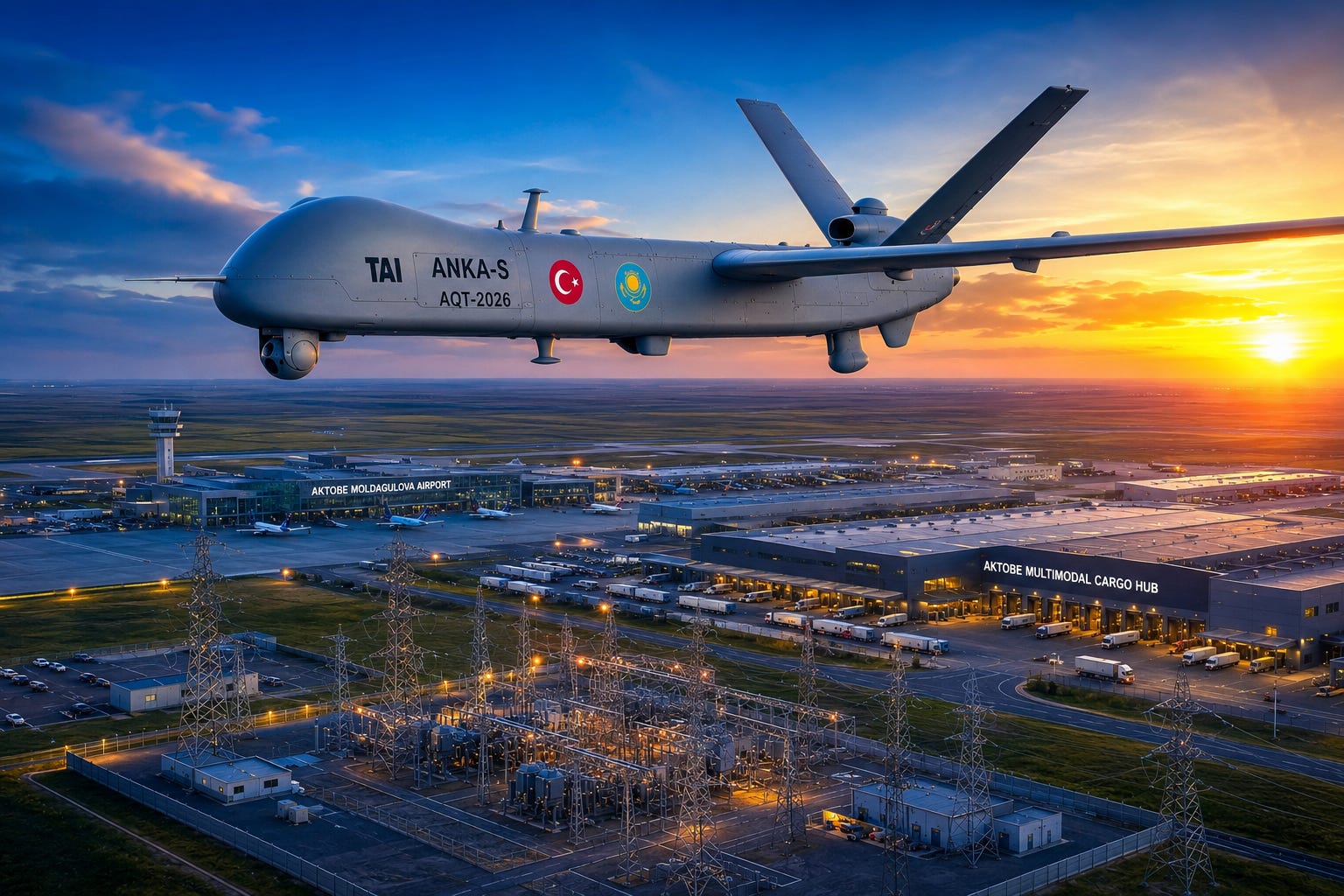
For years, the Western Kazakhstan investment map has followed a simple rule: go to Atyrau for upstream oil, Mangystau for Caspian port plays, and treat Aktobe as the industrial footnote in between. Important, yes. But definitely overlooked.
That needs some re-calibration.
Three things are happening simultaneously in Aktobe right now: a Turkish cargo logistics joint venture (JV) is going up at the city’s international airport, a landmark aerospace technology transfer is being anchored at an 86-year-old repair plant on the same airfield perimeter, and the oblast’s structural power deficit is creating a private infrastructure gap that few have priced. None of this has broken through to Western media. All of it is real, sourced, and moving on a near-term timeline.
I. The Logistics Anchor: A Turkish Operator Bets on Aktobe’s Airport
The physical centerpiece of this story is a 15,000-square-meter multimodal warehouse complex being built at Aliya Moldagulova International Airport.
A formal groundbreaking ceremony was held at the airport, attended by Aktobe Oblast Deputy Akim Galymzhan Yeleyov, S Sistem Lojistik Chairman Huseyin Barlin, a representative of Kazpost, and Aktobe Airport CEO Dastan Maliyev. The ceremony took place in accordance with President Tokayev’s national address “The Economic Course of a Just Kazakhstan” -- a framing that signals this is not a regional initiative, but a nationally mandated infrastructure priority.
At the ceremony, Barlin stated directly: “The construction of the logistics hub will contribute to increasing trade volumes and strengthening relations between our two brotherly countries.” He also specifically thanked the leadership of Aktobe Oblast and the airport for their role in making the investment decision happen.
On 24 July 2025, the operating joint venture -- Qazpost-Sistem Ltd. -- was formally registered at the Astana International Financial Centre (AIFC). The partners are Kazpost (the national postal operator, a Samruk-Kazyna subsidiary) and S Sistem Lojistik, a Turkish logistics group founded in 1999 that operates roughly 100,000 m² of warehouse space across four major Turkish airports: Istanbul, Ankara, Izmir, and Antalya. The JV will manage freight forwarding and warehousing at Aktobe Airport. Commissioning is targeted for the second half of 2026.
Samruk-Kazyna Chairman Nurlan Zhakupov confirmed the timeline: “This project will be commissioned in the second half of 2026. It will realize Kazakhstan’s transit potential.”
The official Aktobe Akimat statement projects that after the hub opens, cargo traffic through Aktobe Airport will increase significantly, with new dedicated cargo flight routes expected to launch. That is the commercial pipeline S Sistem is building toward.
The corridor context matters here. At the Kazakh-Turkish Business Forum in May 2026, President Tokayev cited the S Sistem Lojistik logistics center by name as a flagship example of Turkish private capital in Kazakh aviation infrastructure, alongside TAV Holding’s reconstruction of the Almaty Airport terminal. Presidential-level visibility for a project most analysts have not yet noticed.
The commercial logic rests on the Middle Corridor’s structural growth. A few data points:
Kazakhstan controls approximately 85% of Middle Corridor (Trans-Caspian International Transport Route, or TITR) freight flow
Container traffic along the corridor grew 36% in 2025, reaching 76,900 TEUs (Twenty-foot Equivalent Units -- the standard measure for shipping container volumes)
Tokayev’s stated target: 10 million tons of annual throughput
In 2026, risk around the Strait of Hormuz has pushed additional freight toward the corridor, with the Baku-Tbilisi-Kars railway reportedly hitting physical capacity under the surge
Aktobe sits at the northern approach to that corridor, the last significant logistics node before the route descends toward the Caspian port complex at Aktau and Kuryk. An air-to-ground multimodal facility here fills a genuine gap. For freight forwarders, e-commerce operators, and supply chain managers mapping China-to-Europe cargo flows, Aktobe is positioning itself as the primary breakbulk and transshipment option for Western Kazakhstan, where none currently exists at scale.
S Sistem has also signaled expansion intent beyond the initial hub: Astana, Almaty, Shymkent, and Aktau are in their stated pipeline. Aktobe, as the first JV and the one cited at the presidential level, holds the flagship position in that rollout.
II. The Aerospace Catalyst: From Soviet Repair Shop to ANKA Production Base
If the logistics JV is the commercial anchor, what happened at the same airport in May 2026 is the story that reframes Aktobe’s industrial identity entirely.
On 14 May, at Astana’s Palace of Independence, a joint venture agreement for the production and maintenance of ANKA unmanned aerial vehicles in Kazakhstan was signed between Turkey’s Secretariat of Defense Industries (SSB) and Nurlan Kuzhayev, president of JSC Aircraft Repair Plant No. 406 Civil Aviation in Aktobe. Kazakhstan becomes the first country outside Turkey to manufacture the ANKA system.
What Plant No. 406 Is
The facility was founded in 1939. Its territory spans 370,000 m², with 52,993 m² of active production floor. It sits directly adjacent to Aktobe International Airport, sharing the airfield perimeter. For the better part of nine decades, it has repaired Soviet-era light aviation: the Antonov An-2 biplane and the Mil Mi-2 helicopter, holding a CIS-wide monopoly certification for ГТД-350 turboshaft engine and ВР-2 main gearbox overhaul. Current headcount: 240 people.
What the ANKA Is
The ANKA is a Medium-Altitude Long-Endurance (MALE) unmanned aerial vehicle developed by Turkish Aerospace Industries (TAI), with $3 billion in annual sales and over 50 active programs. Key specs:
Payload capacity: 350+ kg
Endurance: 30 hours
Operating ceiling: 9,000 meters
Sensors: Aselsan CATS electro-optical targeting system, satellite communications (SATCOM) telemetry
Munitions: Roketsan MAM-L laser-guided precision weapons
Autonomous flight computer handles takeoff, navigation, and return-to-base without operator input
It entered Turkish Armed Forces inventory in 2017 and has seen extensive operational deployment in Syria and Libya. Kazakhstan has agreed to co-manufacture 30 units locally, beyond the three already delivered under the initial 2021 contract.
How Production Actually Starts: The CKD Pathway
It is worth being precise about what “local production” means in practice at this stage -- because the realistic entry point is actually where the long-term value lies.
Plant 406 will not be fabricating raw carbon-fiber composite airframes on day one. The program will almost certainly begin via Complete Knock-Down (CKD) kit assembly: TAI ships pre-manufactured structural components and sub-systems from Turkey, and Plant 406 assembles, integrates, and tests the finished aircraft in Aktobe. This is standard practice for first-generation overseas defense manufacturing programs. TAI followed the same model with Indonesia’s ANKA order, where six of twelve units were assembled locally rather than delivered complete.
The CKD pathway is not a limitation -- it is the deliberate architecture of the technology transfer. The skills that Plant 406 builds first are systems integration, avionics calibration, SATCOM configuration, and final acceptance testing. These are the high-value, knowledge-intensive capabilities that sit at the top of the aerospace manufacturing value chain, and they are the foundation on which deeper localization is built over successive production batches.
The localization roadmap runs in a clear direction:
Entry: CKD kit assembly and systems integration. TAI-manufactured components arrive in Aktobe for final assembly and acceptance testing. Plant 406 builds its workforce, tooling infrastructure, and quality systems around the platform.
Mid-term: Sub-component localization. As the production relationship matures, progressively more components are sourced or fabricated locally: wiring harnesses, structural brackets, ground support equipment, and maintenance, repair and overhaul (MRO) tooling.
Mature: Composite fabrication and full MRO capability. Carbon-fiber airframe work, avionics overhaul, and platform life extension become viable as the workforce and facility infrastructure reach the required technical standard.
The 30-unit co-manufacture commitment provides the production run length needed to actually execute that progression. A short-run program would stall at CKD indefinitely. Thirty units across a multi-year schedule gives TAI and Plant 406 the time and volume to push localization meaningfully forward.
The Civilian Overspill Thesis
The defense contract is the mechanism. The commercial story is what comes after. The capabilities built through CKD assembly and progressive localization -- avionics integration, SATCOM systems, autonomous flight software, precision testing environments -- map directly onto underserved civilian applications across the Kazakh steppe:
Pipeline corridor surveillance -- Western Kazakhstan’s oil and gas infrastructure spans thousands of kilometers of remote terrain, most of it currently monitored by ground patrol
Precision agricultural telemetry for large-scale grain and livestock operations in Aktobe and surrounding oblasts
Border and infrastructure monitoring for Kazakhstan’s security and natural resource agencies
GIS (Geographic Information System) mapping for the mining and resource sector
A workforce that has spent several years integrating SATCOM systems and calibrating autonomous flight computers is not going to stay inside a defense plant fence line forever. So, early-stage investors should be watching this region for spin-off ventures in the above areas as the program matures.
The drone story and the logistics story share more than a geographic address. Both are anchored by Turkish capital. Both received direct presidential endorsement at the same bilateral summit in May 2026. Both are deploying at the Aktobe airfield. That is a coordinated industrial bet, not a coincidence.
III. The Energy Play: Reading a Power Deficit as a Market Signal
Every industrial build-out runs into a physical constraint. In Aktobe, that constraint is electricity. For investors who can read a grid balance sheet, it is the most actionable opportunity in the story.
As we’ve covered in the first report of The Kazakhstan Briefing, the country faces a structural generation deficit that forces western regions into uncomfortable reliance on Russian balancing imports -- and Aktobe Oblast sits at the center of that pressure.
The National Deficit, Quantified
In October 2025, KEGOC Chairman Nabi Aitzhanov stated publicly at a Samruk-Kazyna council meeting:
“At a projected peak electrical load of 17.6 GW, maximum generation is expected around 18.7 GW. Capacity deficit is forecast at 900 MW. Monthly electricity deficit is expected in the range of 125-330 million kWh. Total electricity deficit for the heating season may exceed 1 billion kWh.”
That gap is covered by imports from Russia and Uzbekistan. The price mechanics are telling: during January-May 2025, Kazakhstan imported Russian electricity at 7.64 US cents per kWh, while exporting domestic surplus power to Russia at 1.89 cents per kWh. A spread of more than 4:1. Kazakhstan imports at peak-hour pricing and exports during off-peak surplus hours. This is a market signal, not a policy failure.
Aktobe’s Local Picture
The oblast’s own consumption trajectory is among the most aggressive in the country:
4.4% average annual electricity consumption growth, 2015-2024 -- well above the 2.9% national average
The Aktobe Ferroalloy Plant (ERG/TNC KazKhrom subsidiary) consumed 3,518 million kWh in 2024, up from 1,934 million kWh in 2015 -- an 82% increase in nine years, making it Kazakhstan’s third-largest industrial electricity consumer
In 2014, the plant’s new Shop No. 4 added four 72-MW DC furnaces, at the time the most powerful of their kind globally
Now layer the new loads on top of that baseline. The airport logistics hub and the ANKA production facility both represent high-value, voltage-sensitive industrial consumers that cannot tolerate grid instability. A cargo sorting hub going dark during a peak winter evening is a contractual liability. An avionics calibration environment that experiences a voltage fluctuation produces scrap.
These are fundamentally different in their power quality requirements from the legacy ferroalloy and rail industry. Furnace loads tolerate grid variability. Precision manufacturing and automated cargo systems do not.
The Private Infrastructure Opportunity
Kazakhstan’s national grid modernization plan allocates $1.029 billion to Aktobe Oblast for 2026-29 -- the second-largest single-oblast allocation in the entire national program, predominantly extra-budgetary.
Two Combined Cycle Gas Turbine (CCGT) projects are formally committed for Aktobe on the national pipeline. A CCGT is a modern gas-fired power plant that captures waste heat to generate additional electricity, making it significantly more efficient than a conventional gas turbine:
Aktobe CCGT (Energy Flow Generation, auction-awarded) -- 250 MW, targeting 2028
Aktobe CCGT (investment agreement) -- 250 MW, targeting 2030
That is 500 MW of new dispatchable capacity planned for the oblast. As of early 2026, however, none of Kazakhstan’s auction-winning CCGT projects nationally had been commissioned. The pipeline is clear, but the execution is lagging.
That gap is where private capital finds its entry. Three specific opportunity categories are well-defined:
Industrial microgrids. The airport logistics complex and Plant 406 are physically concentrated sites with predictable load profiles -- exactly the conditions that make behind-the-meter generation and storage financeable.
Hybrid wind-solar with Battery Energy Storage Systems (BESS). Aktobe Oblast’s steppe geography has well-documented wind resources. Hybrid projects coupled with battery storage can deliver stable, dispatchable power to precision industrial consumers at premium tariffs, independent of the national grid’s reliability constraints.
Substation and distribution infrastructure. The $1.029 billion modernization envelope requires engineering contractors, equipment suppliers, and project finance. Western energy engineering firms have a clear and credible entry point here.
The Investment Case Summary
Aktobe is executing a multi-axis industrial transformation, anchored at a single geographic node, with credible institutional partners, on a near-term timeline. The three layers are distinct but reinforcing.
Logistics: The Qazpost-Sistem JV puts a 15,000 m² multimodal hub at Aktobe Airport online in H2 2026, operated by a Turkish group with proven airport logistics DNA.
Entry points: supply chain partnerships, freight forwarding relationships, last-mile distribution infrastructure for Western Kazakhstan.
Aerospace: The TAI/Plant 406 ANKA production JV is in active setup phase, with 30 units planned for local co-manufacture via CKD assembly and progressive localization.
Entry points: manufacturing supply, precision tooling, ground support equipment, and the dual-use technology spin-offs that follow a maturing aerospace workforce.
Energy: A 900 MW national capacity gap, $1.029 billion in Aktobe grid investment, and two planned CCGTs still years from commissioning create a well-defined private infrastructure window.
Entry points: Independent Power Producer (IPP) development, industrial microgrids, hybrid BESS projects, and the engineering contractor pipeline for the modernization program.
None of these layers are fully built. Investors or vendors who wait for proof of concept will find the pricing has moved.
Western Kazakhstan has long been the territory of upstream oil majors. Aktobe is the first city in this region making a credible case that the next chapter of its industrial story is being written by aerospace engineers and logistics operators, not just rig crews.
The construction phase is open and the opportunity is now.
Primary sources for this piece include Kursiv.kz, the official Aktobe Akimat press portal, S&P Global Energy Research, KEGOC Annual Report 2024, and reporting from Caspian News, Asia Plus, Qazinform, and Turkiye Today.